Creative Evening on 27/02/2024

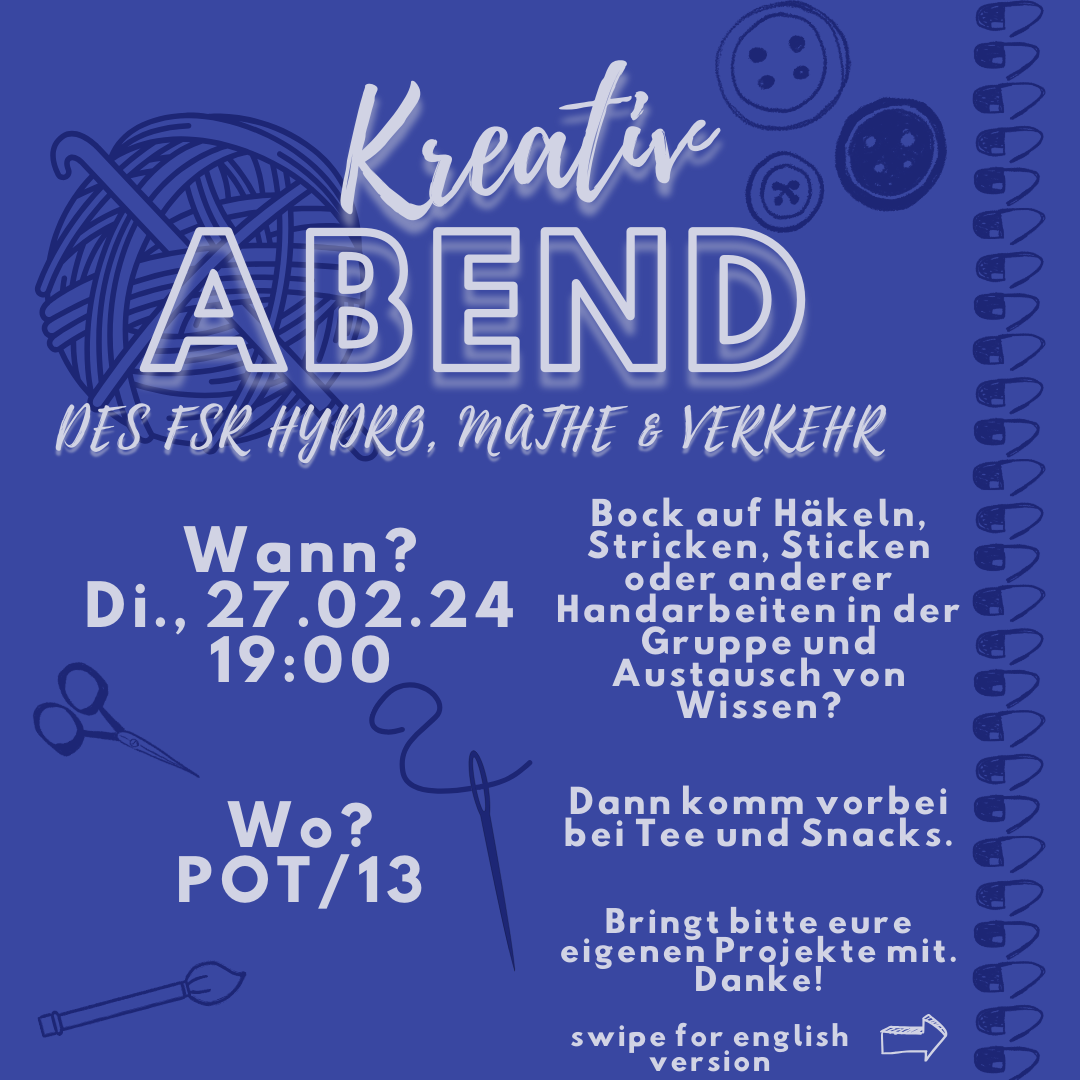
On Tuesday 27th February 2024 from 7:00 PM in POT/13 the next creative evening will take place. This time in cooperation with FSR Hydro und FSR Mathe.
If you lack motivation to complete a project or are looking for inspiration on what to do next, just come along.
Whether you want to do handicrafts, crochet, knit or draw, you are welcome to give free rein to your creativity over tea and snacks. And you can also meet lots of nice people from the Hydrosciences, Mathematics or Transport Sciences departments.
There will be wool available, but otherwise just bring the materials you want to work with.
Searching for programme coordinator

YOU want to help improve the quality of your degree programme?
YOU know where the problems are and already have countless ideas on how to fix them?
YOU are tired of waiting for something to change and want to see results during your studies?

A student programme coordinator (Studiengangskoordinator:in) is appointed for each degree programme for one year starting 1 April. They connect the students with the university, the university committees and the student council (FSR). First and foremost, they deal with all matters relating to the degree programme. You are the contact person for questions and problems relating to the quality of your degree programme and an advisory member of the Study Commission (Studienkommission). Irrespective of this, you can of course also make your own suggestions for improvement and implement them in collaboration with the academic programme coordinator.

For this purpose, we are looking for a programme coordinator (Studiengangskoordinator:in) for each degree programme (VIW Dipl., VWI Ba., TEc Ma., EVS Ma., BSI Ma., LuLo/ATL Ma.). You can have this work recognised as ungraded AQUA.

Enrolment for programme coordinators takes place via OPAL. Feel free to write to us for further information or simply drop by the FSR office in person.

Participate at Dresden’s Mobil-O-Mat

As part of Mobility Planning 2035+, Dresden City Council is calling on its citizens to become active in transport planning themselves using the interactive Mobil-o-Mat tool. They can choose from 50 measures in the categories of walking, cycling, bus & rail, car & commercial transport, networked mobility, electric drives, parking and urban development & road space. According to the city, the results, i.e. the prioritisation of the participants, represent an “important building block” for the strategic orientation of transport planning. Further information can be found here.

For students of our faculty, this offers both a glimpse behind the scenes of the city’s transport planning and an opportunity to help shape it.